 [ad_1]
Presently, the New York Inventory Alternate’s core buying and selling hours are 9:30 a.m. to 4 p.m. ET, Monday by way of Friday. But it surely hasn’t at all times been that approach.
Within the early days of the NYSE, per its website, “brokers gathered twice a day to trade a list of 30 stocks and bonds,” then “from the podium the president called out the name of each security in turn, while the brokers shouted bids and offers from the chairs assigned to them.” (Sounds chaotic.)
By the 1870s, they'd decided that particular buying and selling hours have been crucial and developed a schedule that has been tweaked a number of instances prior to now few centuries. Now, we could also be one other adjustment.

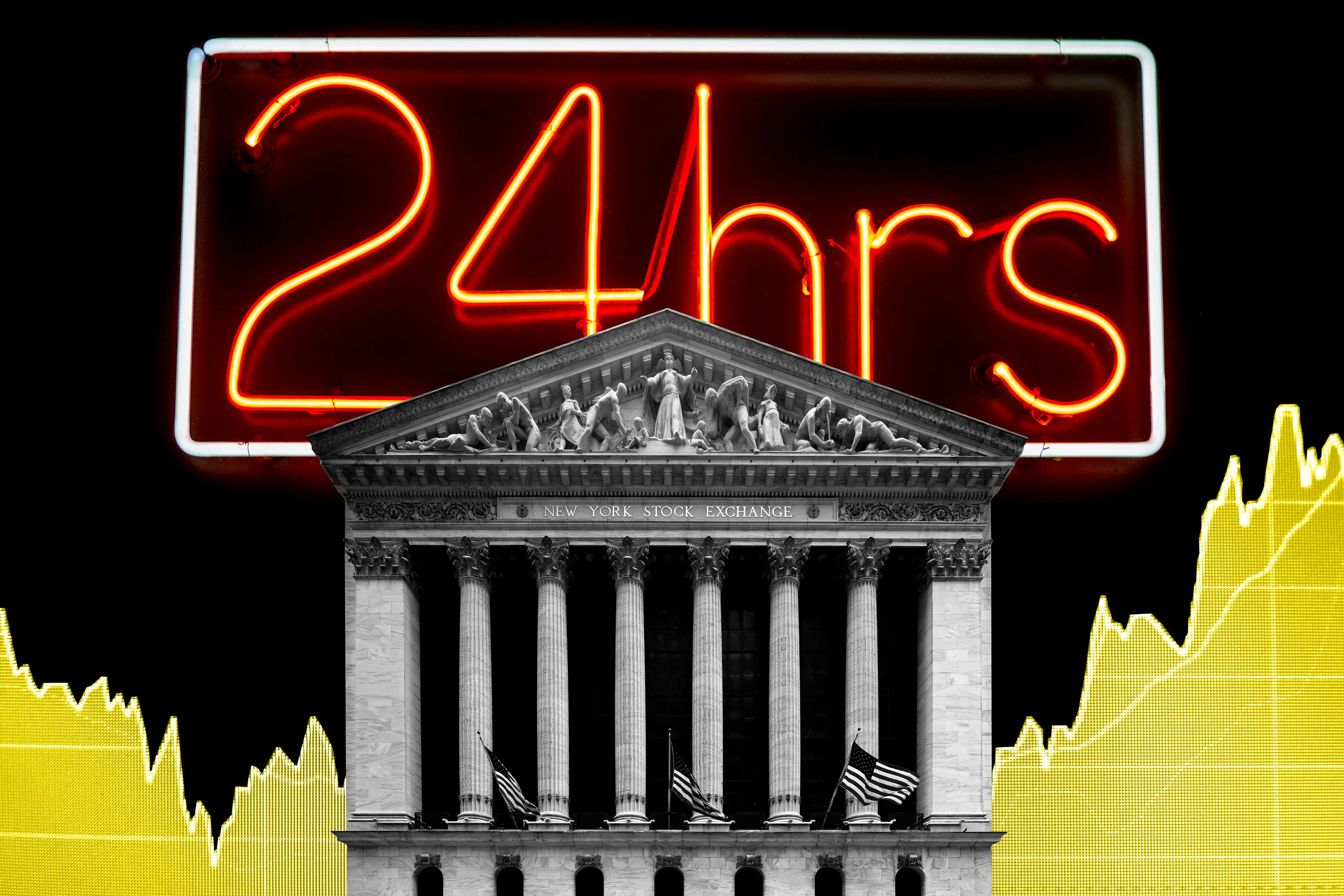
Just a few weeks in the past, the Monetary Instances reported that the NYSE has begun “polling market participants on the merits of trading stocks around the clock.” And whereas the NYSE is only one inventory alternate of many, it's the world's largest, so this is able to be an enormous shift with main repercussions.
“If you want to go onto Amazon and pick up a sweater or something, it's available to you 24/7,” says Andrew Crowell, vice chairman of wealth administration at D.A. Davidson. “We’re in an on-demand world now.”
Is it time for the New York Inventory Alternate to catch up?
Deserves of round the clock inventory buying and selling
Having this dialogue now really makes a variety of sense, in line with Stephanie Guild, head of funding technique at Robinhood. Inventory buying and selling has turn into more and more digital over time, however the rise of cryptocurrency — which trades nonstop — has given the dialog new urgency.
So has the uptick in digital merchants taking part in present after-hours markets. Robinhood, as an example, presents 24-hour buying and selling for sure shares and ETFs 5 days per week. It’s seen over $10 billion in in a single day trades since launching in Could 2023.
Growing world market demand is an element, as properly. Guild says foreign money values are partially pushed by a distinction in rates of interest. As you already know except you've got been residing beneath a rock, the U.S. has had particularly excessive rates of interest these days, which has supported a powerful greenback and elevated curiosity in U.S. equities.
However in the event you’re an investor residing overseas who desires to put money into the U.S. market to make the most of this, the NYSE hours could be difficult: “You’d be up in the middle of the night,” Guild provides.
The alternate's present hours of operation could be a hurdle for U.S. traders, too.
Crowell says a 24-hour market could be handy for merchants who've theories they'd like to check out by shopping for or promoting shares forward of open.
“People want to express their investment philosophy, and they don't want to wait for the whole world to wake up,” he provides. “They want to be able to silently get ahead of the crowd.”
Cons of a 24/7 NYSE
Whereas expanded hours would give traders the chance to comply with by way of on their instincts, a choice by the NYSE to maneuver to round the clock hours might additionally include detrimental penalties.
For one, the 9:30-to-4 schedule serves as form of a guardrail, stopping many traders from making impulsive selections in response to their feelings or the information.
That is no small factor, since analysis means that probably the most profitable traders are often those who experience out the highs and lows and keep dedicated to their overarching objectives... which could possibly be undone by accessing the market a 24/7 (or 24/5, for that matter).
“The long-term goal is to allocate properly, hold on and be committed to your investment plan,” Crowell says. “I do worry that on a 24-hour, Monday through Friday exchange, people will panic at the wrong time — that second glass of Chardonnay is not a good precursor to making a buy or sell decision on a Tuesday night.”
There’s additionally a danger related to value discovery, which is the act of figuring out a value for an asset. As a result of volumes are highest on the opening and shutting bells, Crowell says, that’s when traders can get the truest studying of what one thing is value.
“To get the most accurate, available price in the marketplace, you want to have the most trading volume possible,” he says. “The difficulty with a 24-hour exchange would be that if Julia wants to sell her shares at 2 in the morning, there's going to be a buyer — but that buyer could have an undue impact on being able to dictate price to you.”
Admittedly, not everybody would upend their schedules instantly. Guild predicts the biggest quantity of stock trading would nonetheless come from U.S. establishments, and people trades would nonetheless occur in the course of the day, if the NYSE have been open 24 hours.
Which means it might be further necessary for merchants to watch out about what they're moving into, on condition that the market can react in a technique throughout lower-volume periods and a distinct approach approach throughout high-volume ones.
Even so, Guild says she's hopeful a 24-hour inventory market would make value motion rather less unstable. Assume: If expanded hours led to extra round the clock quantity, we might see extra various opinions a couple of inventory quite than just some gamers’.
And if these gamers are good about it, they might make this work to their benefit.
“If you really are committed to staying disciplined, being able to trade 9 o’clock at night Eastern shouldn't change your strategy,” she says.
Extra from Cash:
Should I Buy Stock in Companies I Like?